Generative Engine Optimization (GEO) for Saudi Businesses: The Complete Guide to Getting Cited by AI Search
A complete guide to Generative Engine Optimization (GEO) for Saudi and Gulf businesses: what it is, how ChatGPT, Google AI Overviews, Perplexity and Bing Copilot choose sources, and how to get cited — not just ranked.
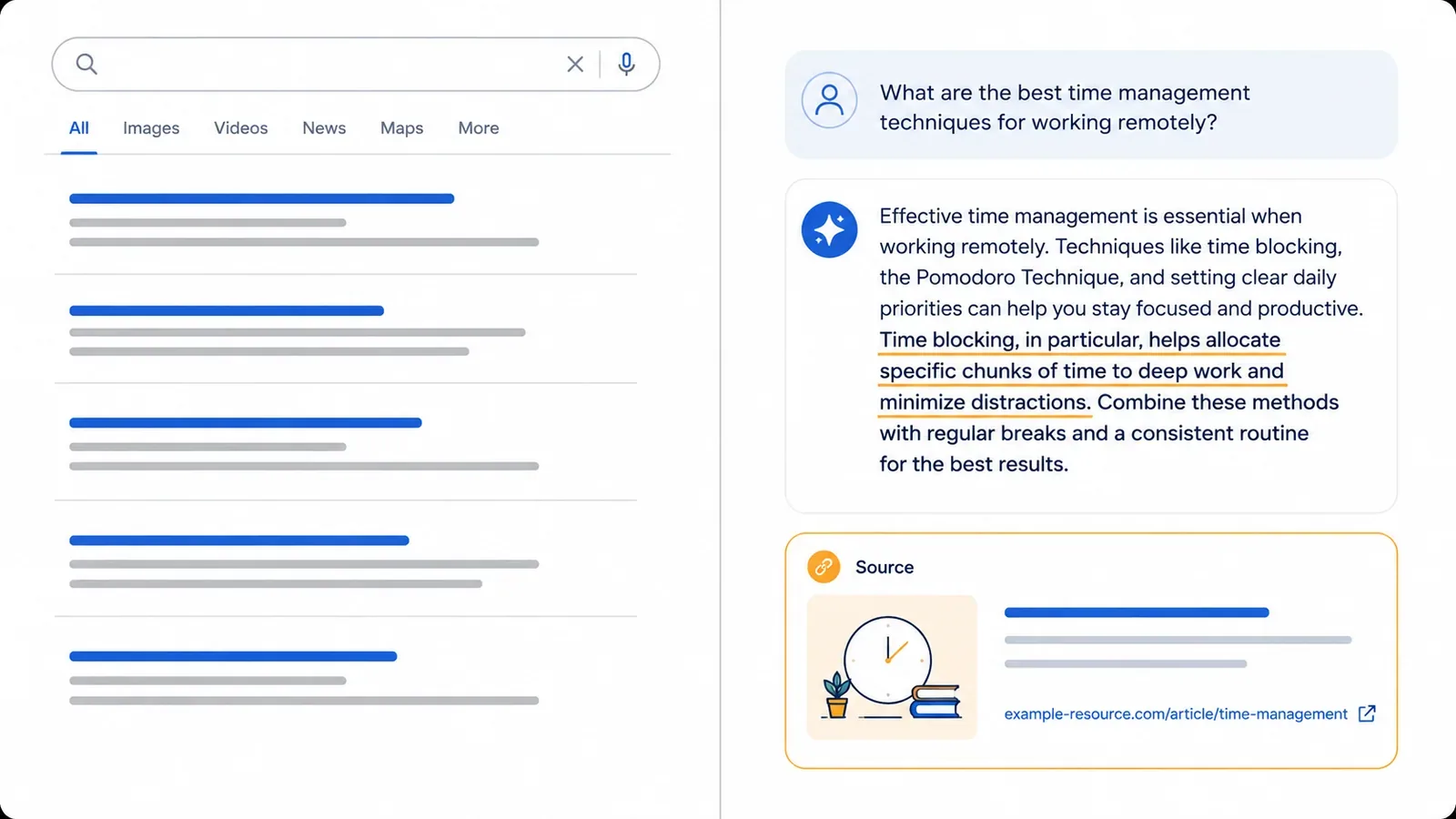
Generative Engine Optimization, or GEO, is the practice of structuring a website's content so that AI systems — Google AI Overviews, ChatGPT, Perplexity, Bing Copilot — can extract it, trust it, and cite it directly in an answer. It matters now because a growing share of searches in Saudi Arabia and the Gulf end on an AI-generated summary rather than a list of ten blue links, and a business that never appears in that summary loses the visibility moment entirely, regardless of where it ranks in traditional search results.
Saudi Arabia is an unusually AI-forward market to get this wrong in. Smartphone and mobile-data penetration are among the highest in the Gulf, WhatsApp is the default channel most businesses use to close a sale rather than a contact form, and Vision 2030's digital-economy push has put generative AI tools in front of Saudi consumers and enterprises faster than in most markets. A business whose content only exists in Arabic marketing copy written for humans, with no structured, extractable English or Arabic passages, is easy for an AI system to skip over even when it is the most relevant source available.
This guide covers what GEO actually is and how it differs from SEO and AEO, the retrieval mechanics behind how AI systems choose what to cite, how to structure content so it can be extracted, how to measure whether any of this is working, the specific gap Saudi and Gulf businesses face with Arabic content, and a realistic 90-day roadmap for a business starting from zero. A cluster of more detailed guides sits underneath this one, published as they’re ready.
What Is GEO, and How Is It Different From SEO and AEO?
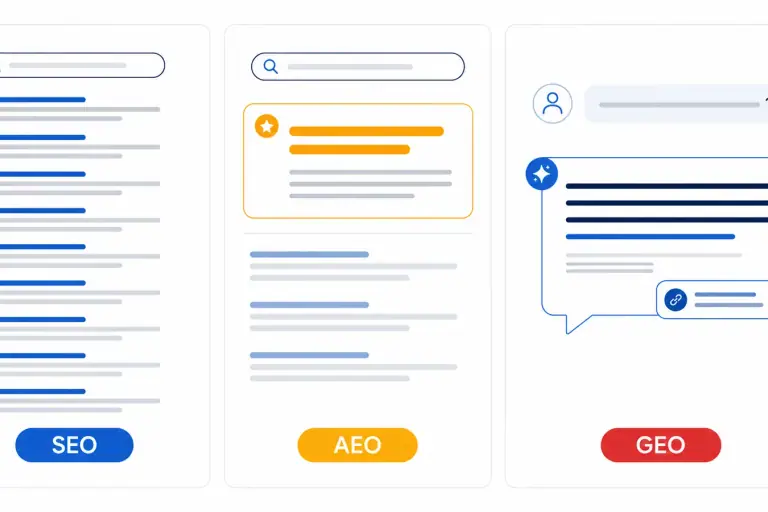
GEO is the discipline of optimizing content to be retrieved and quoted by generative AI systems, as distinct from SEO, which optimizes to rank in a list of links, and AEO (Answer Engine Optimization), which optimizes to be the single direct answer served for a specific query — often the featured snippet or voice-assistant response. The three overlap heavily in the underlying work (technical health, clear structure, credible entities) but differ in what "success" looks like and how it's measured, which is why treating GEO as "SEO with extra AI keywords" tends to produce content that ranks fine and gets cited never.
The clearest way to see the difference is side by side:
- SEO — Goal: rank a page in the search results list. Unit of optimization: the page/URL. Success metric: ranking position, organic clicks. Example tactic: title tags, backlinks, page speed.
- AEO — Goal: be selected as the single direct answer. Unit of optimization: the answer passage. Success metric: featured snippet / voice answer wins. Example tactic: concise 40-60 word answer blocks targeting one query.
- GEO — Goal: be extracted and cited inside an AI-generated response. Unit of optimization: the fact, claim, or passage — often smaller than a full page. Success metric: citation frequency, share of AI answers referencing the brand. Example tactic: clear entity definitions, structured data, self-contained passages an LLM can lift verbatim.
A page can rank well and still never get cited by an AI system, and a page can get cited by ChatGPT without ranking anywhere on page one of Google, because the two systems retrieve content differently. We've written a full breakdown of the geo vs seo vs aeo difference, including where the disciplines genuinely conflict (SEO sometimes rewards padding a page out; GEO punishes it). If a business is running solid SEO and still invisible in AI answers, the diagnosis usually isn't "SEO is broken" — it's a separate, related question of why is my website not appearing in ai search results, which we cover as its own topic because the causes (crawler blocks, thin extractable content, missing entity signals) are distinct from ranking problems.
How AI Search Engines Actually Decide What to Cite
AI search systems decide what to cite by running a retrieval step before generation: the model (or a search layer bolted onto it) pulls a shortlist of candidate sources from an index or a live web search, ranks passages within those sources for relevance and extractability, and then generates an answer that weaves in the passages it judged most directly useful — and how many sources make it into a given answer varies by platform, query, and length — there is no fixed count to write toward. This means a page competes not as a whole document but passage-by-passage, and a passage that directly states a fact in one self-contained sentence beats a passage that implies the same fact across three paragraphs of narrative copy.
The mechanics differ by platform in ways that matter for what a Saudi business should prioritize. Google AI Overviews draw primarily from Google's own index, so standard technical SEO and structured data still carry weight — a page invisible to Googlebot is invisible here too. ChatGPT's search mode blends its training knowledge with live retrieval through Bing's index for time-sensitive or unfamiliar queries, which means Bing Webmaster Tools and Bing indexing matter more for ChatGPT visibility than most businesses assume. Perplexity runs its own crawler and search index and is unusually aggressive about citing multiple sources per answer, often rewarding niche or highly specific pages that a Google-only strategy would ignore. Bing Copilot sits close to ChatGPT's retrieval behavior since both lean on the Bing index.
None of these systems will ever guarantee that a specific page gets cited for a specific query — citation, like ranking, is decided by the platform against every other candidate source and signals outside any one business's control. What increases the likelihood of citation is consistent: clear entity definitions, direct answers stated in the first sentence of a section, and technical accessibility to each platform's crawler.
The Technical Side — Structuring Content So AI Can Extract It
Structuring content for AI extraction means writing a clear, self-contained direct answer near the top of a section, before any elaboration, and backing it with structured data (Schema.org markup) that states the same facts in a machine-readable format — because AI crawlers and retrieval systems favor passages that are unambiguous, self-contained, and don't require the reader (or the model) to piece together context from surrounding paragraphs. A page that opens every section with throat-clearing and builds to the point six paragraphs later is technically well-optimized for a human skimmer and poorly optimized for an LLM deciding in milliseconds whether a passage is quotable.
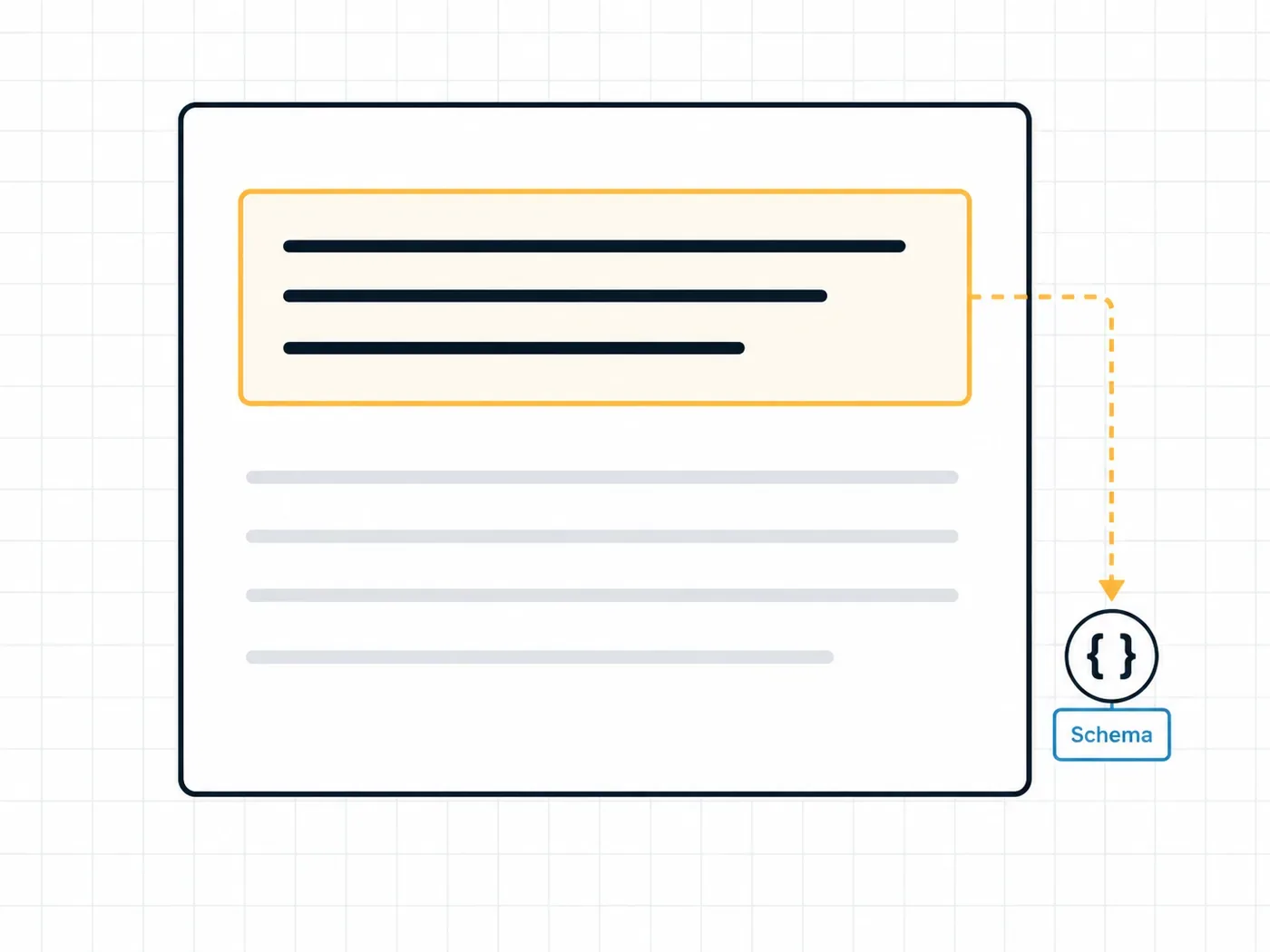
Three structural elements matter most in practice. First, heading hierarchy that mirrors actual questions — an H2 phrased as a question a person would type into ChatGPT retrieves better than a clever marketing headline. Second, structured data that matches the visible text exactly: FAQPage schema listing a question whose answer text doesn't appear anywhere on the visible page is a mismatch that can get the page ignored rather than helped, since crawlers cross-check schema against rendered content. Third, technical crawlability for AI-specific bots — GPTBot, PerplexityBot, Google-Extended, and ClaudeBot each have their own user-agent strings, and it's common to find them accidentally blocked in a robots.txt file that was written before any of these crawlers existed, which silently removes a site from that platform's retrieval pool entirely.
These structural elements — question-shaped headings, schema that matches visible text, and open crawler access — are the foundation the rest of this series builds on as it publishes.
How to Know If GEO Is Working — Measurement and Tools
Measuring GEO means tracking whether a brand or page is actually being cited in AI-generated answers, which is a different data source than traditional rank tracking and currently has no single authoritative tool the way Google Search Console is authoritative for organic search — most measurement today combines manual prompt testing, brand-mention monitoring tools, and referral-traffic analysis from AI platforms as a proxy signal. Anyone promising a precise "AI ranking position" the way SEO tools report a Google position number is overstating what current tooling can actually see.
In practice, three signals are usable today. Referral traffic segments in Google Analytics 4 increasingly show sessions from chatgpt.com, perplexity.ai, and copilot.microsoft.com as distinct referral sources — a rising trend here is a real, measurable proxy for AI visibility even without a citation count. Manual and semi-automated prompt testing — running a consistent set of relevant queries against ChatGPT, Perplexity, and Google's AI Overview on a schedule and logging whether and how the brand is mentioned — remains the most direct check, tedious as it is. And a newer category of dedicated AI-visibility trackers has emerged specifically to automate that prompt-testing process at scale, though the category is young enough that no single tool has become the default the way Ahrefs or Search Console has for SEO.
Measurement is worth its own detailed treatment — methodology, tooling, and the question of whether this needs a separate specialist — in guides we’re publishing as this series continues.
GEO for Saudi and Gulf Businesses — the Arabic Content Gap and Local Considerations
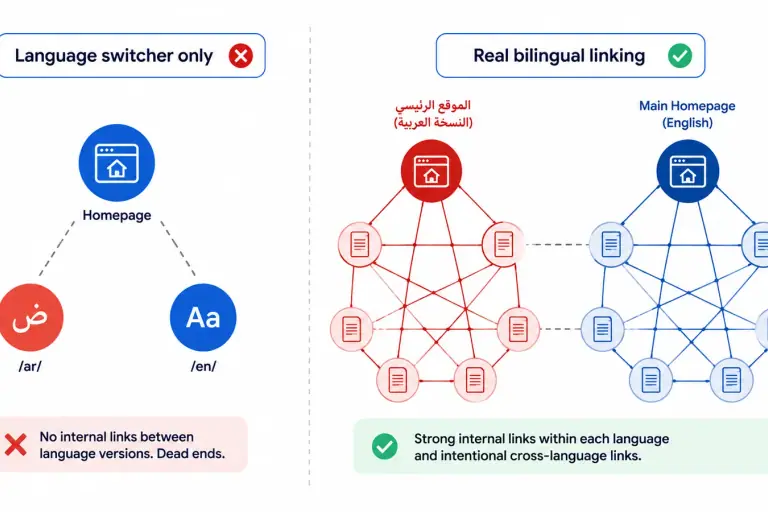
Saudi and Gulf businesses face a specific GEO gap that global guides don't address: most AI systems are trained and evaluated overwhelmingly on English-language content, so Arabic-language pages — even well-written, technically sound ones — are retrieved and cited less consistently than English equivalents, and machine-translated Arabic content performs worse still because it reads as low-confidence to both human readers and extraction models. A Saudi business publishing only in Arabic, or publishing Arabic content that was translated rather than written to stand on its own, is starting several steps behind in AI visibility even if its Arabic SEO is otherwise solid.
This shows up in three concrete ways worth planning around. Dialect and register matter more to AI extraction than to a human skimmer — Modern Standard Arabic content structured with clear headings extracts more reliably than colloquial Gulf Arabic copy written for social media tone. Bilingual businesses often get more AI citation value from a well-structured English page than from an equivalent Arabic one for the same query, simply because the retrieval pool for that query is deeper in English — which argues for genuinely bilingual content strategy rather than treating Arabic as a translation afterthought. And Saudi Arabia's mobile-first, WhatsApp-centric buying behavior means a meaningful share of commercial queries never reach a business's own website at all; as AI answers increasingly settle informational and comparison queries before a click ever happens, the businesses that show up inside the AI answer itself capture the moment that used to belong to whoever ranked first — a genuine shift in where the zero-click search impact on paid ads saudi arabia question is heading, and one we're covering separately.
Two related topics get dedicated treatment elsewhere in this cluster: a companion piece on the Arabic-vs-English performance gap is planned for this cluster, and how to optimize Arabic content for AI search is a practical guide to closing it — covering native Arabic content structure, when English content genuinely outperforms Arabic for the same query, and how to avoid the machine-translation trap. If you're deciding whether this is a project to run in-house or bring in outside help, GEO services pricing in Saudi Arabia lays out how engagements in this market are typically scoped and priced.
A 90-Day GEO Roadmap for a Saudi Business
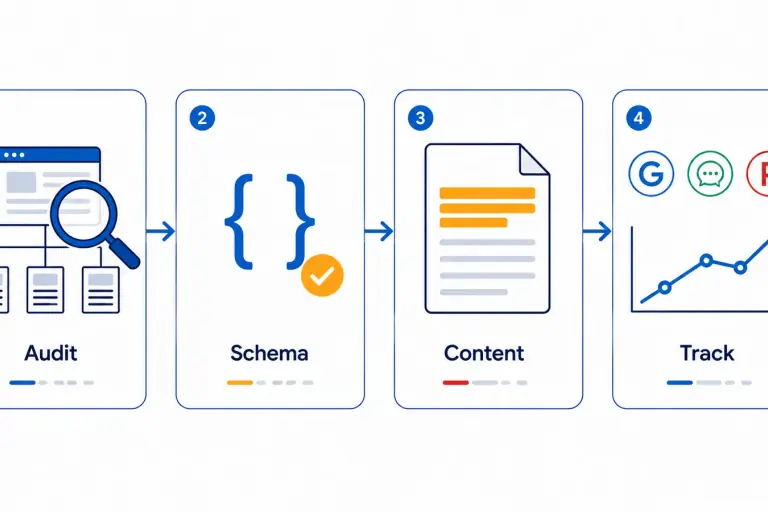
A realistic 90-day GEO roadmap starts with a technical and crawlability audit in weeks 1-2, moves through content restructuring and schema implementation across weeks 3-8, and spends weeks 9-12 on measurement setup and a first round of prompt-testing to establish a baseline — because GEO work compounds over months as AI systems re-crawl and re-index, not overnight, and a 90-day window is enough to see early directional signal without promising results no one can control.
Weeks 1-2: Audit. Check whether AI crawlers (GPTBot, PerplexityBot, Google-Extended, ClaudeBot) are blocked in robots.txt. Audit existing structured data against what's actually visible on the page. Identify which pages already rank well in traditional search but likely fail extraction — usually pages with long, narrative paragraphs and no direct-answer structure. Establish a baseline: run 15-20 relevant prompts against ChatGPT, Perplexity, and Google's AI Overview and record what currently gets cited, if anything.
Weeks 3-8: Rebuild. Rewrite priority pages so every major section opens with a 40-150 word self-contained direct answer. Add or correct Schema.org markup (Article, FAQPage, Organization, HowTo where relevant) so it matches the visible text exactly. Address the Arabic content gap directly — decide, page by page, whether a topic needs a genuinely bilingual treatment or whether English alone is currently the stronger asset for that specific query. Fix any technical blockers found in the audit.
Weeks 9-12: Measure and iterate. Set up AI-referral tracking in GA4. Re-run the baseline prompt set and compare. Treat the first 90 days as a foundation-laying phase, not a results guarantee — this is a discipline that keeps compounding as more content gets restructured and as AI systems re-index the changes, and a genuine refresh cycle (revisiting this guide and its data points at least every 90 days) matters more here than in traditional SEO because platform retrieval behavior itself keeps shifting.
Frequently Asked Questions
Q: What is Generative Engine Optimization (GEO)? A: GEO is the practice of structuring website content so AI systems like ChatGPT, Google AI Overviews, and Perplexity can extract, trust, and cite it in generated answers. It focuses on self-contained, direct-answer passages and structured data rather than just ranking a page in a results list, since AI systems retrieve and quote individual passages rather than whole documents.
Q: Is GEO the same thing as SEO? A: No. SEO optimizes a page to rank in a list of search results, while GEO optimizes specific passages to be extracted and cited inside an AI-generated answer. The two share foundations — technical health, credible entities, clear structure — but a page can rank well without ever being cited by an AI system, and vice versa, because the retrieval mechanics differ.
Q: Can nibras guarantee our business will be cited by ChatGPT or Google AI Overviews? A: No, and no agency honestly can. Which sources an AI system cites is decided by that platform against every other candidate source and signals outside anyone's control, so a guarantee of citation isn't a claim worth making. What can be committed to is the work — technical crawlability, structured data, answer-first content — that increases the likelihood of citation over time.
Q: How long does GEO take to show results? A: Most businesses see early directional signal — referral traffic from AI platforms, initial citations on tested prompts — within 60-90 days of restructuring priority content and fixing technical blockers. Full results compound over longer periods since GEO depends on AI systems re-crawling and re-indexing changes, which happens on each platform's own schedule, not on demand.
Q: Do Saudi businesses need separate Arabic content for AI search? A: Often, yes, but not always as a straight translation. Arabic content that's written to stand on its own, with clear structure and direct answers, extracts more reliably than machine-translated Arabic — and for some queries, a well-structured English page currently outperforms an Arabic equivalent simply because more AI training and retrieval data exists in English for that topic.
Q: Does GEO replace SEO, or do we need both? A: Both are needed. Traditional search still drives significant traffic in Saudi Arabia and globally, and strong technical SEO remains a prerequisite for AI visibility on platforms like Google AI Overviews that draw from the same index. GEO adds a distinct, additional layer of work — passage-level structure and platform-specific extractability — rather than substituting for SEO fundamentals.
Q: Should we block AI crawlers like GPTBot from our site? A: It depends on which crawler. GPTBot and ClaudeBot gather content for model training, not live search — blocking them opts out of training data without changing whether ChatGPT or Claude can cite the site in a real-time answer. OAI-SearchBot is OpenAI's separate crawler for ChatGPT Search, and Google's AI Overviews run on the standard Googlebot rather than Google-Extended (which only governs Gemini training data). If live citation is the goal, OAI-SearchBot and Googlebot are the crawlers to verify first — and accidental blocks of any of these are still worth auditing, since they happen more often than deliberate ones.
Last updated: August 30, 2026
GEO isn't a switch to flip once — it's an ongoing discipline that compounds as content gets restructured and as AI platforms keep changing how they retrieve and cite sources. If you want a technical audit of where your site currently stands with AI crawlers and structured data, or an ongoing visibility retainer, get in touch through our contact page.
The nibras newsletter
Practical articles on marketing, branding and search visibility, sent to your inbox. No spam, and you can unsubscribe in one click.

Want our new articles first?
Grow Your Brand in KSA
Work with nibras in Riyadh. Let our experts shape your strategy, premium content, and advertising campaigns for Saudi markets.