GEO vs SEO vs AEO: What's the Difference, and Do You Need All Three?
SEO, AEO, and GEO compared side by side: what each one optimizes for, which AI/search surfaces they target, and why most businesses need all three working together, not one instead of another.
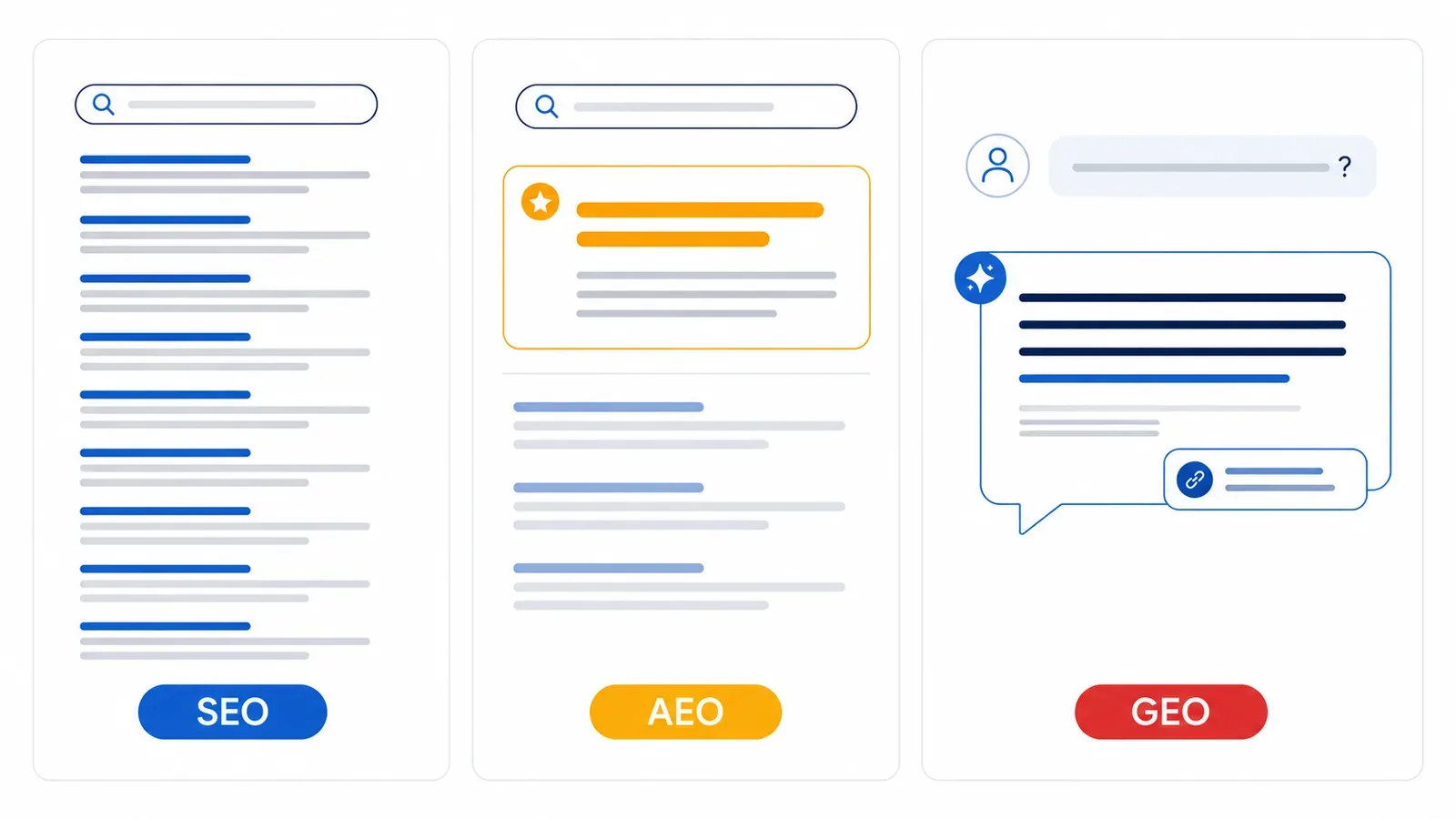
SEO, AEO, and GEO are three names for optimizing three different surfaces, not three competing strategies. SEO gets a page ranked in Google's list of blue links. AEO gets an answer pulled into a featured snippet, a "People Also Ask" box, or a voice result. GEO gets a brand mentioned and cited inside an AI-generated answer from ChatGPT, Google AI Overviews, or Perplexity. Most Saudi businesses need all three, because customers now search across all three surfaces in the same week — sometimes the same session.
The confusion is understandable: all three rely on similar technical groundwork — crawlable pages, clean structure, credible content — so it's easy to assume mastering one makes the others unnecessary. It doesn't. This guide compares them side by side, then gives a practical order to work on them if a business can't do everything at once.
SEO vs AEO vs GEO at a Glance
The three disciplines differ on four practical points: what they aim for, where the result shows up, how success is measured, and what a team actually does day to day. SEO optimizes whole pages to rank in organic listings, measured by position and traffic. AEO optimizes specific passages to win a direct-answer placement, measured by snippet ownership. GEO optimizes facts and structure to earn a citation inside a generated answer, measured by citation frequency and AI-driven referral traffic. The table below lines them up directly.
- SEO — Goal: rank the page itself in organic search results. Target surface: Google/Bing organic results ("ten blue links"). Success metric: keyword rankings, organic sessions, click-through rate. Example tactic: title tags, backlinks, page speed, keyword-mapped content.
- AEO — Goal: get a specific passage selected as the direct answer. Target surface: featured snippets, "People Also Ask," voice assistants. Success metric: snippet ownership, voice-result share, answer-box impressions. Example tactic: concise 40-60 word answers near the top of a section, FAQ formatting.
- GEO — Goal: get the brand mentioned and cited inside an AI-generated response. Target surface: ChatGPT, Google AI Overviews, Perplexity, Bing Copilot. Success metric: citation frequency, brand mention rate, AI-referral traffic (e.g., sessions tagged
utm_source=chatgpt.com). Example tactic: plainly stated facts, consistent entity naming, structured data an AI crawler can parse.
SEO — Ranking in the Ten Blue Links
SEO is the practice of getting a whole page to rank as high as possible in a traditional results list, measured by position, organic traffic, and click-through rate rather than by whether one sentence gets quoted. It's the oldest of the three disciplines and the one most Saudi businesses already have some version of, even if inconsistent. The unit SEO optimizes is the page: its title tag, backlink profile, load speed, and keyword targeting.
What SEO does not guarantee is a specific position — Google decides rankings against every competitor and signal in the market, and nobody outside Google controls that outcome. What can be built, deliberately, is the foundation: technical health, clear content structure, and pages that actually match what the searcher typed. That foundation is also the starting point for AEO and GEO, which is why SEO rarely gets replaced — it gets built on.
AEO — Winning the Direct Answer, Snippet, or Voice Result
AEO optimizes a specific passage, not a whole page, so Google or a voice assistant selects it as the direct answer — a featured snippet, a "People Also Ask" expansion, or a spoken response from Siri or Google Assistant. Success is measured by whether that passage gets chosen at all, a binary outcome per query rather than a graded position like SEO rankings. The tactic is narrow: a 40-60 word answer stated plainly near the top of a section, phrased close to how the question is actually asked.
AEO sits between SEO and GEO in age and mechanics. It predates generative AI by years — featured snippets and voice search were already answer-engine behavior before ChatGPT existed — but writing a self-contained, extractable answer is exactly the skill GEO also depends on. A page built for AEO is usually most of the way to being GEO-ready already.
GEO — Getting Cited Inside AI-Generated Answers
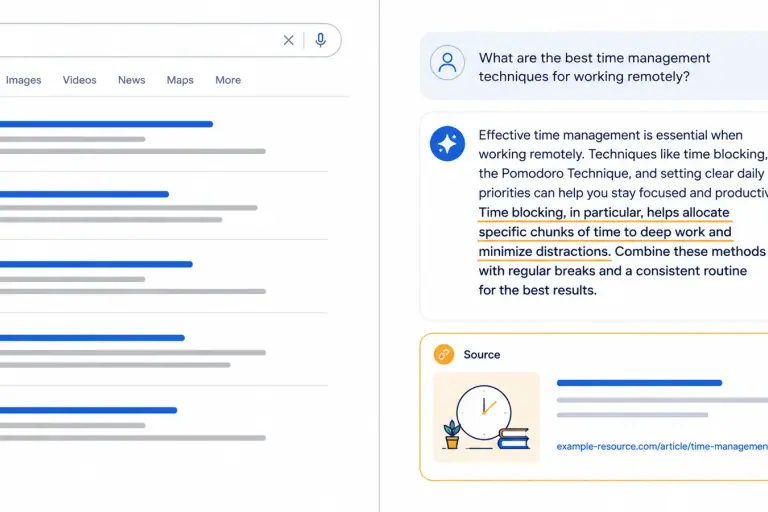
GEO optimizes a different unit entirely: not a page or passage, but the facts and structured data an AI model draws on when it generates an answer and, sometimes, names a source. Success is measured by citation frequency and by AI-referral traffic tracked directly — links from ChatGPT Search arrive tagged with utm_source=chatgpt.com, so that traffic shows up in analytics rather than being estimated. Core tactics: consistent entity naming across the web, facts stated outright instead of implied, questions answered in question form, and structured data the AI crawler can parse.
GEO is also called Generative Engine Optimization, and it's sometimes labeled AEO too — the two terms describe overlapping work and get used almost interchangeably in the wider industry. We generally lead with the plain description rather than either acronym, for a practical reason: in Saudi search results, "GEO" commonly returns geotechnical and geospatial companies, and "AEO" collides with Authorized Economic Operator, the customs classification. Saying "AI search optimization" avoids sending a business owner down the wrong search result entirely.
Where They Overlap, and Where They Diverge
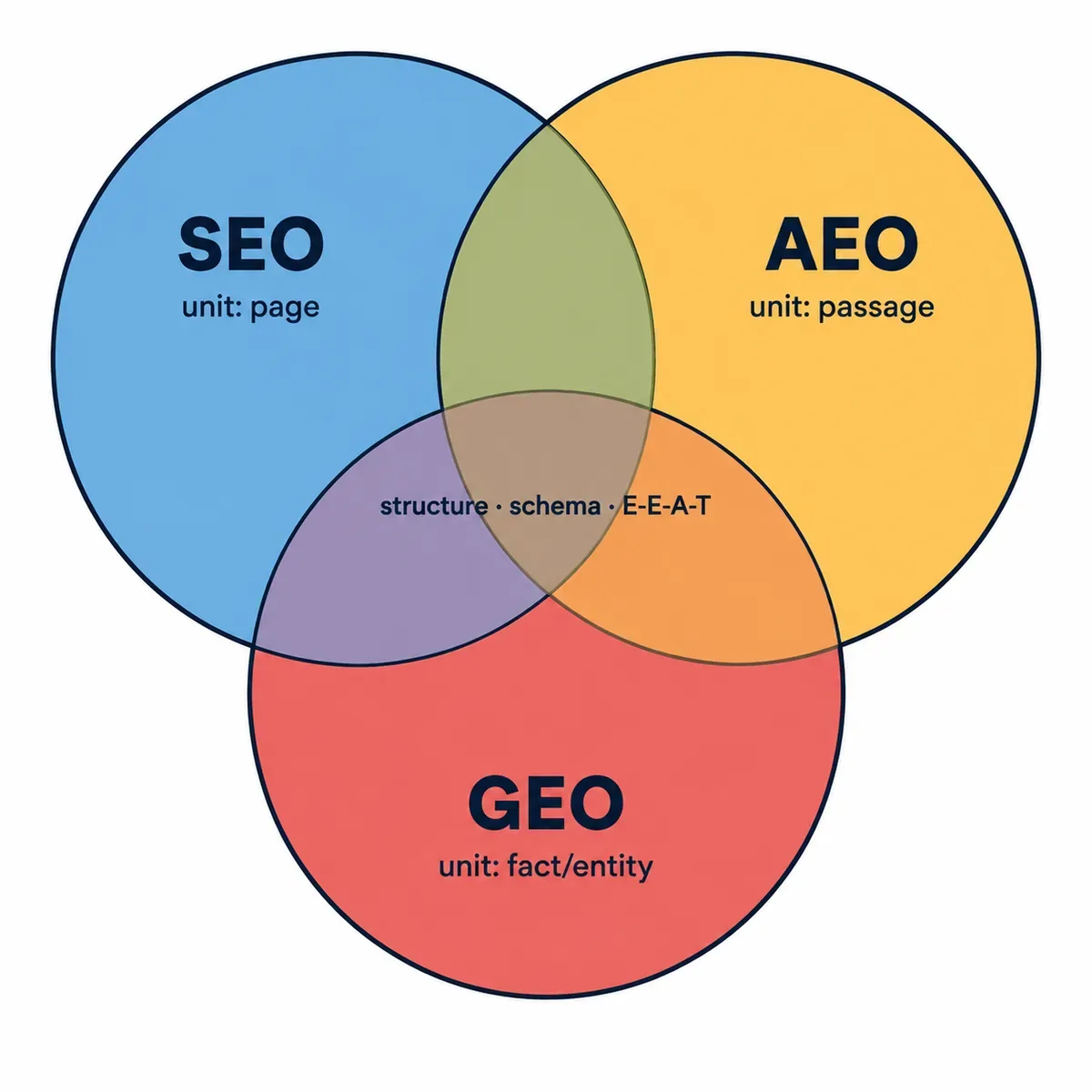
SEO, AEO, and GEO overlap almost completely at the technical foundation — clean site structure, accurate structured data, crawlable content, and genuine E-E-A-T signals serve all three — but diverge sharply in what they optimize as the unit of success. SEO optimizes the page, AEO optimizes the passage, GEO optimizes the fact and entity. That's a real distinction, not rebranding: a page can rank well in Google while never being selected as a snippet and never once getting cited by ChatGPT, because each discipline rewards a different shape of content.
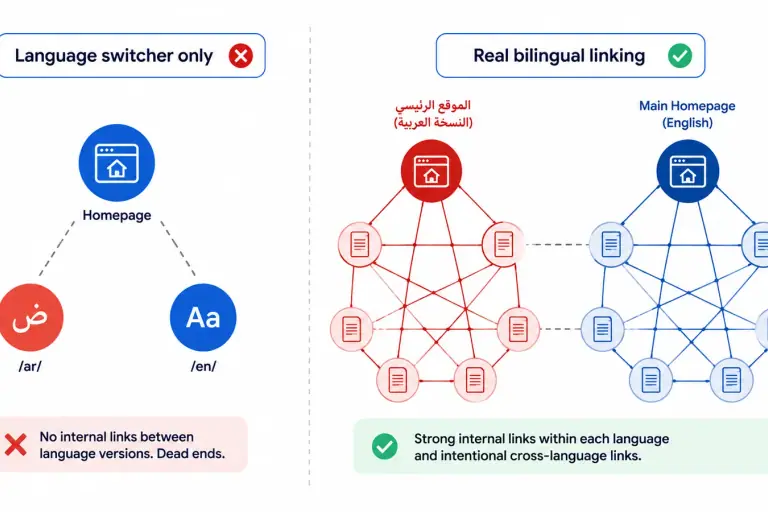
Arabic-language content adds a layer none of the three global playbooks address by default — Arabic and English aren't one market split into two languages, they're different search behaviors with different query phrasing and competitor sets, so content built for one rarely transfers cleanly to the other. That's covered in how to optimize Arabic content for AI search.
Which One Should a Saudi Business Prioritize First?
A business with no SEO foundation should start with SEO regardless of size, because AEO and GEO both depend on the same crawlable, well-structured base — skipping it means building AEO or GEO tactics on nothing. Beyond that, priority depends on the business model. An e-commerce brand in a competitive Riyadh category should weight SEO and AEO heavily, since product pages compete on ranking and on snippet-style comparison queries. A professional services firm — legal, consulting, medical — gets disproportionate value from GEO, because clients increasingly ask ChatGPT or Perplexity to recommend a provider rather than scrolling a results page. A local retail business with a physical location should prioritize SEO paired with local signals first, since GEO citation matters less when the decision hinges on proximity and store hours.
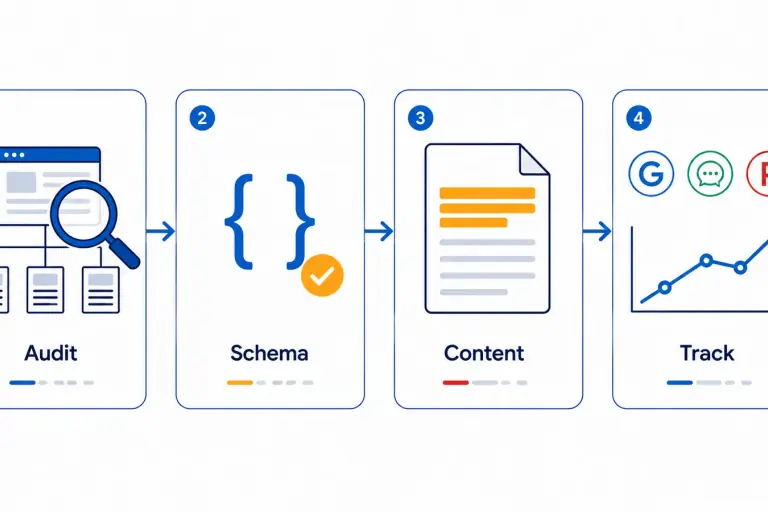
For most established Saudi businesses, the realistic path is running all three in parallel rather than sequencing them strictly, since the technical foundation is shared and extending it to cover AEO and GEO costs less than building each from scratch later. What that costs and how it's typically packaged is covered in GEO services pricing in Saudi Arabia. For a fuller walkthrough of GEO mechanics — how AI engines actually select and cite sources — see the complete guide to GEO AI search optimization in Saudi Arabia.
One more comparison worth having before hiring anyone: a generalist SEO agency and a GEO-focused agency don't do identical work, even when the proposals look similar on paper. That distinction — GEO agency vs. SEO agency — deserves its own detailed comparison and isn't covered fully here.
FAQ
Does GEO replace SEO? No. GEO and SEO optimize different surfaces — GEO targets citations inside AI-generated answers, SEO targets ranking position in traditional search results — and both surfaces still carry real search volume in Saudi Arabia. Dropping SEO to focus only on GEO means losing the organic traffic that still comes from the ten blue links, which remains the larger channel for most businesses today.
Is AEO the same thing as GEO? They describe closely overlapping work. Both optimize content so it can be extracted and presented as a direct answer rather than browsed as a full page, and industry usage of the two terms overlaps heavily. The meaningful difference is the surface: AEO traditionally covers featured snippets and voice assistants, while GEO specifically covers generative AI tools like ChatGPT and AI Overviews.
Which should a small Saudi business do first: SEO, AEO, or GEO? SEO first, because AEO and GEO both build on the same technical foundation — clean structure, crawlable pages, credible content — that SEO already requires. A small business with no organic search presence gets little value from GEO tactics layered onto a site that isn't indexed or structured well in the first place.
Can one agency handle SEO, AEO, and GEO together? Yes, when the agency treats them as one technical foundation with three measurement layers, not three separate services. Because the underlying work — structure, schema, entity consistency, content quality — is shared, splitting it across separate vendors usually creates duplicated audits rather than better results.
How is GEO success actually measured, since there's no ranking position? Two ways: tracking whether a brand gets mentioned and cited across a fixed set of AI prompts checked on a schedule, and measuring AI-referral traffic directly, since links from tools like ChatGPT Search arrive tagged with utm_source=chatgpt.com in analytics. Neither method offers a guarantee of citation — only Google, OpenAI, and similar platforms control that outcome — but both make the trend measurable over time.
Last updated: August 30, 2026
Have a question about where your business should start? Get in touch with nibras and we'll walk through it.
The nibras newsletter
Practical articles on marketing, branding and search visibility, sent to your inbox. No spam, and you can unsubscribe in one click.

Want our new articles first?
Grow Your Brand in KSA
Work with nibras in Riyadh. Let our experts shape your strategy, premium content, and advertising campaigns for Saudi markets.