How to Optimize Arabic Content for AI Search
A practical guide to optimizing Arabic-language content for ChatGPT, Bing Copilot, and AI Overviews: internal linking, schema in Arabic, hreflang setup, and entity naming for bilingual brands.
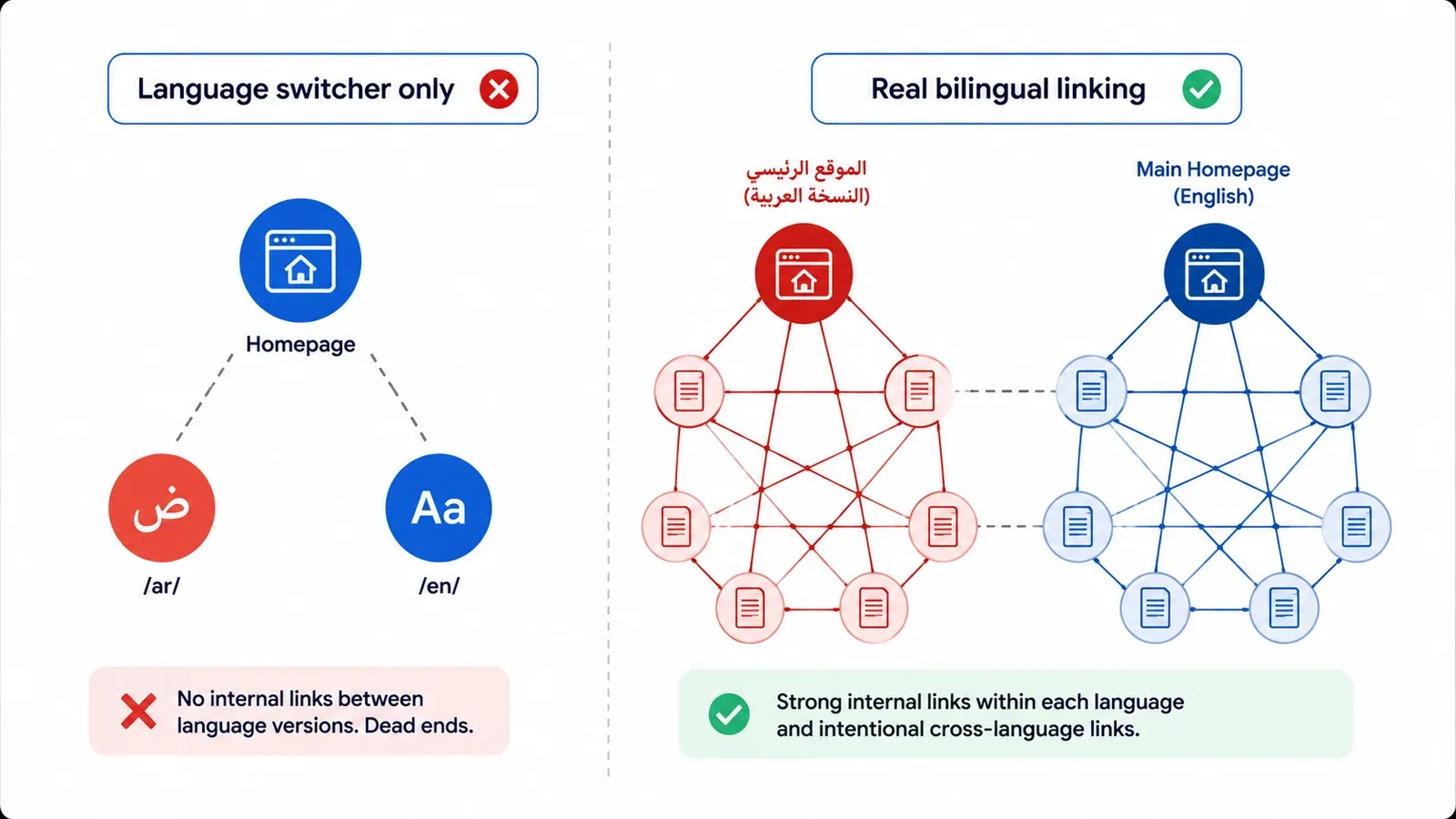
Most Arabic pages that fail to get cited by AI search were never actually built for it — they were built as an English site with an Arabic copy attached. The four fixes that move the needle are: real internal linking between Arabic pages instead of just a language switcher, structured data written in Arabic rather than only on the English side, correct hreflang pairing so AI crawlers know the two versions are equivalent, and one consistent entity name across your Arabic and English identity, tied together with sameAs. None of these are exotic. All four are usually missing, even on sites that otherwise rank well in English.
This matters more for GEO AI search optimization Saudi Arabia than it ever did for classic SEO, because generative engines lean harder on structured signals — links, schema, consistent naming — to decide what a page is about and whether to trust it enough to quote. A page that reads fine to a human but gives an AI crawler no clean signal in Arabic gets skipped in favor of a competitor's page that does, even a weaker one.
Fix 1: Build Real Internal Linking Between Arabic Pages
A language switcher is not internal linking — it swaps the whole page, it doesn't tell a crawler how your Arabic content relates to itself. Real internal linking means Arabic pages link to other Arabic pages contextually, the way your English pages already link to each other, so AI crawlers can map your site's topical structure in Arabic on its own terms rather than inferring it from the English version.
Most bilingual sites we look at have a fully linked English section and an Arabic section that's just a set of orphaned pages reachable only from the homepage switcher. That structure tells search engines and AI crawlers that Arabic is an afterthought, not a parallel property. It also means an AI engine answering an Arabic-language query has no path from your Arabic homepage to your Arabic service or blog pages — so even if the content itself is good, the engine has no reason to consider it connected, authoritative content rather than an isolated stub.
Fix it the same way you'd fix thin internal linking in English: identify your 8-10 most important Arabic pages, and make sure at least three other Arabic pages link to each one with descriptive Arabic anchor text — not "اضغط هنا" (click here), but anchors that name the destination page's actual topic.
Fix 2: Implement Schema in Arabic, Not Just English Pages
Structured data on your English pages does nothing for your Arabic pages — schema is scoped to the page it sits on, so if your Arabic pages have no JSON-LD, AI crawlers reading them get zero structured signal, no matter how complete your English schema is. Every Arabic page that has a live English equivalent with schema should carry its own, matching Arabic version.
This gets missed constantly because schema is usually added once, by whoever builds the English site, and never revisited when the Arabic pages go live later or get generated from a template that skips structured data. The result is an Arabic page that a human reader can't tell apart from its English sibling in quality, but that carries no Organization, Article, FAQPage, or LocalBusiness markup at all in the language it's actually written in.
At minimum: mirror whatever schema type sits on the English page, translate the field values into Arabic (not just the visible text — the name, description, and headline properties inside the JSON-LD itself), and keep the two versions in sync whenever either page is updated. A separate guide in this series covers which schema types to prioritize for a bilingual site; for now, the rule is simple — no Arabic schema means no Arabic structured signal, full stop.
Fix 3: Use hreflang Correctly for AR/EN Parity
Get it wrong — missing return tags or mismatched language codes — and engines can merge the two pages incorrectly or ignore the relationship entirely. A missing x-default is a smaller gap by comparison: it only matters as a fallback when no language matches the visitor's settings, not a broken pair on its own.
A correct implementation for an Arabic/English page pair looks like this:
<link rel="alternate" hreflang="ar-sa" href="https://example.com/ar/service-page" /><link rel="alternate" hreflang="en-sa" href="https://example.com/en/service-page" /><link rel="alternate" hreflang="x-default" href="https://example.com/en/service-page" />
Three things matter here. First, hreflang tags must be reciprocal — the Arabic page must reference the English page and the English page must reference the Arabic page back, or the pairing is invalid. Second, use the full language-region code (ar-sa, not just ar) if you're targeting Saudi Arabia specifically rather than Arabic broadly. Third, set an x-default so engines have a fallback when neither language matches the visitor's settings. This is a one-time technical fix, not an ongoing content task, which is exactly why it's worth getting right early rather than living with a broken version indefinitely.
Fix 4: Establish Consistent Entity Naming
An entity is how a search engine or AI model identifies "who" is talking — your brand, tied to one canonical identity across every place it appears. If your brand name is written three different ways across your Arabic pages, and your Arabic and English social profiles aren't linked back to each other, engines have to guess whether they're looking at one entity or several. Guessing is where citations get lost.
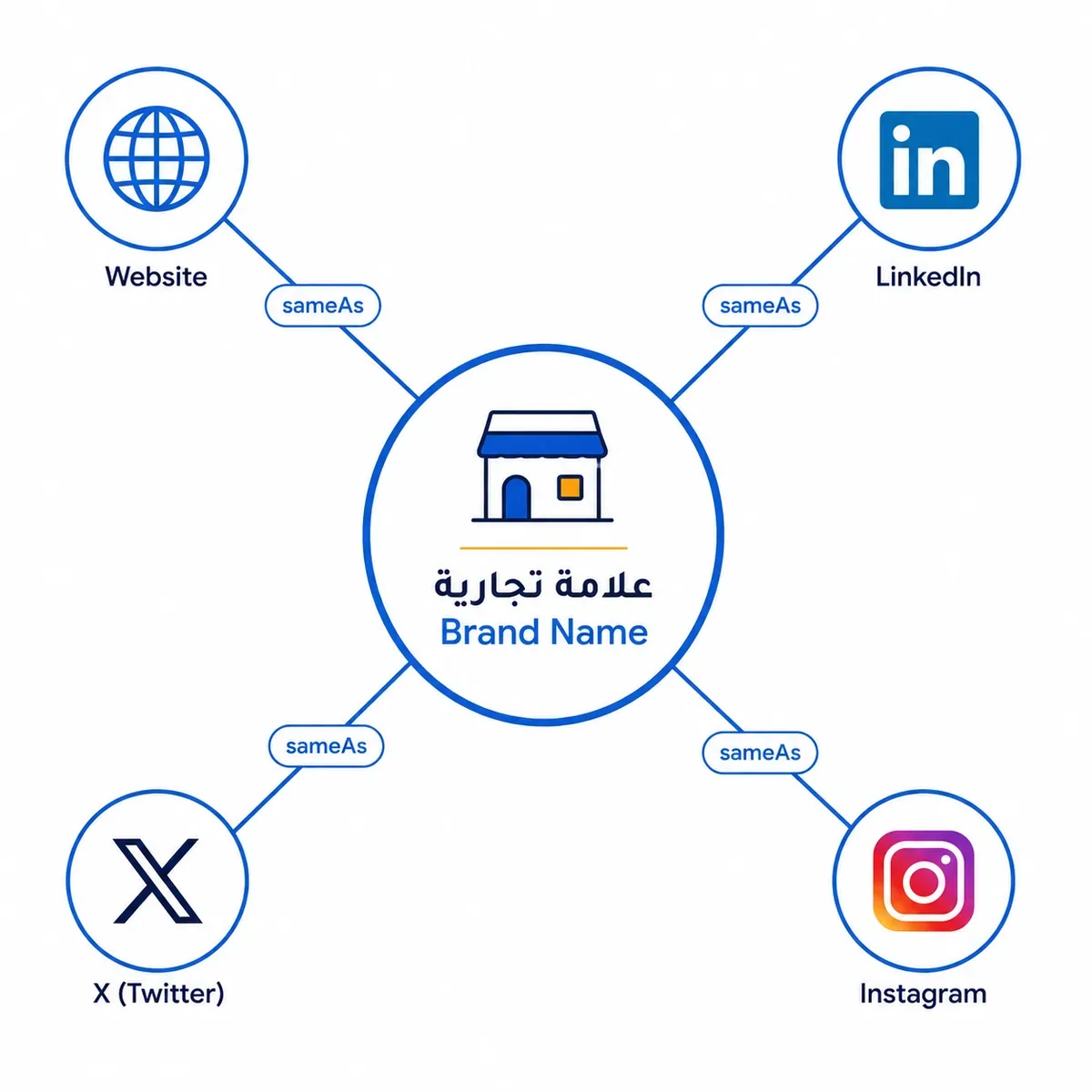
The fix has two parts. First, decide on one canonical Arabic spelling of your brand name and use it identically everywhere — website, schema, social bios, directory listings. Inconsistent spelling (with or without diacritics, different transliterations) fragments your entity across what should be a single identity. Second, use sameAs in your Organization schema to explicitly link your Arabic and English profiles together, so the connection isn't left to inference:
{"@context": "https://schema.org","@type": "Organization","name": "Your Business Name","alternateName": "اسم علامتك التجارية","url": "https://example.com","sameAs": ["https://www.linkedin.com/company/your-company","https://x.com/yourhandle","https://www.instagram.com/yourhandle"]}
alternateName carries the Arabic spelling on the same entity record as the English name, and sameAs points to every profile that represents the same brand elsewhere. Together they tell an AI crawler "these are all one entity," instead of leaving it to piece that together from context — which it often won't.
A Bilingual Publishing Workflow That Doesn't Shortchange Arabic
The workflow fix underneath all four technical fixes is sequencing: Arabic and English content need to ship together, reviewed by someone fluent in each, not translated after the fact from a finished English page. Arabic isn't English with different words — it's a different search behavior, with its own query phrasing, competitor set, and intent patterns — so content built natively for it will out-perform a translation even when the translation is fluent.
In practice that means: write the outline once, then produce both language versions from it in parallel rather than in sequence; give both versions their own schema, internal links, and metadata rather than copying the English technical setup and hoping it "just works" once translated; and assign a real review step for Arabic — grammar, dialect appropriateness, and search intent — rather than treating Arabic QA as a lighter pass than English QA. Sites that skip this and simply translate a finished English page after publication almost always end up with the orphaned-page, missing-schema pattern described above, because the Arabic version was never treated as a first-class page in its own right.
Whether Arabic AI search even performs as well as English right now is a fair question, and a related one — how much of your existing paid traffic is already being displaced by zero-click AI answers — is worth understanding before you decide how much of this workflow to build out first. Cost is the other practical question, and it's covered separately in our breakdown of geo services pricing saudi arabia. What's covered here is the technical foundation either way: without it, neither language performs as well as it should in AI search.
FAQ
Does Google Arabic content need different schema than English content? No — the schema types are the same (Organization, Article, FAQPage, and so on), but the field values inside them must be written in Arabic on Arabic pages. Schema is scoped per page, so an Arabic page with only English-language schema, or no schema at all, gives AI crawlers no structured signal to work from in that language.
Is hreflang enough on its own to rank Arabic content in AI search? No. Hreflang tells engines that two pages are language equivalents, which prevents duplicate-content confusion and helps the right version get served to the right visitor, but it does nothing for content quality, internal linking, or structured data. Treat it as one of four foundational fixes covered here, not a standalone solution — a perfectly tagged page with no Arabic schema or internal links still won't get cited.
Can I just translate my English page into Arabic instead of writing it natively? You can, but it underperforms. Arabic search behavior differs from English in query phrasing, competitor sets, and intent, so a native Arabic page built around how people actually search in Arabic will out-cite a fluent translation of an English-first page almost every time.
Do I need separate URLs for Arabic and English, or can I use one page with a toggle? Separate URLs are strongly preferred over a single toggled page. Hreflang, schema, and internal linking all operate at the URL level, so a single page that swaps content client-side gives crawlers one URL to evaluate instead of two properly linked, independently indexable versions. Separate URLs also let each language build its own internal link equity and get indexed on its own, rather than competing for the same slot.
How often should Arabic schema and hreflang be checked once they're set up? Review them whenever the corresponding English page changes, and run a full pass across the site at least every 90 days regardless. Template updates, CMS migrations, new page builders, and staff turnover are the most common ways hreflang and schema quietly break, and none of them trigger an obvious error — the page still looks fine, it just stops being picked up correctly.
Last updated: August 30, 2026
Getting the technical foundation right is one piece of the picture — if you want a second opinion on where your bilingual setup currently stands, get in touch.
The nibras newsletter
Practical articles on marketing, branding and search visibility, sent to your inbox. No spam, and you can unsubscribe in one click.

Want our new articles first?
Grow Your Brand in KSA
Work with nibras in Riyadh. Let our experts shape your strategy, premium content, and advertising campaigns for Saudi markets.
More from our Blog